

MMPs and mobile attribution: how your data travels from the ad click to campaign optimization
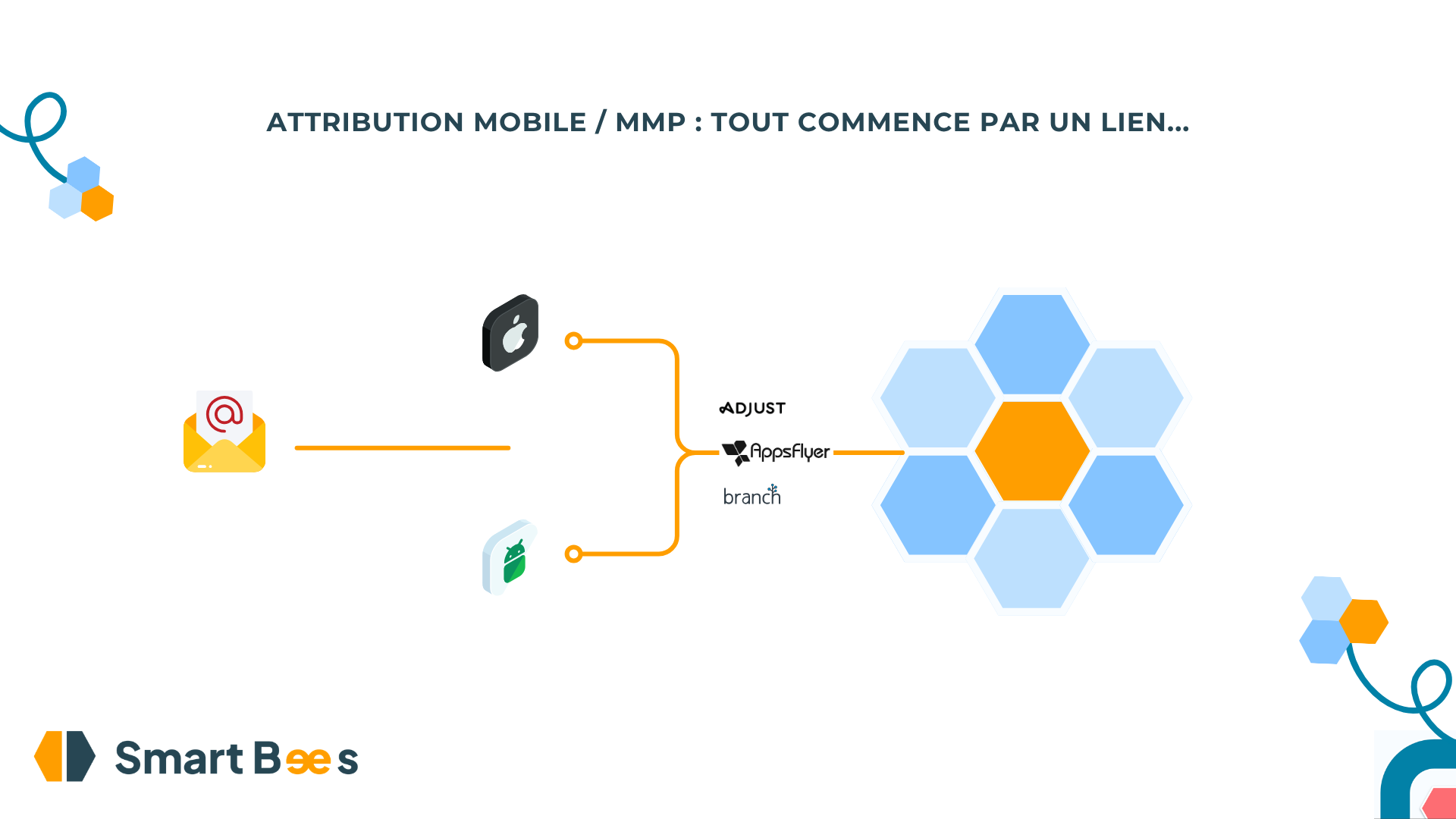
Mobile attribution rests on an MMP (Mobile Measurement Partner) that follows the data from the ad click through to the postback sent back to the network. It records the click, picks up the install through the SDK or the store, arbitrates between the networks claiming the conversion, then sends the event back to Meta or Google to feed their algorithm.
When a user taps an Instagram ad, downloads your app and makes a purchase three days later, how does Meta know that purchase came from its campaign? And more to the point, how can you be sure the figures the network reports are accurate? The answer is the MMP (Mobile Measurement Partner). If you have already read our complete guide to MMPs, you know they exist to measure and attribute installs across your different channels.
In this article we follow the exact journey of the data — from the user's initial click to the moment the ad platform receives the conversion signal it uses to optimize. Understanding that journey is what determines whether your measurement is trustworthy and whether your budget decisions rest on solid ground.
1. MMPs: why add a third party to the chain?
When you invest across several acquisition channels (Meta, Google Ads, TikTok, Snapchat), each platform sends you its own performance report. Naturally, each one credits itself with the conversions its campaigns generated. These platforms are Self-Attributing Networks (SANs): they measure their own results from their own internal data.
The problem shows up when a user interacts with several platforms before installing your app. Add the reports together and you often end up with several installs claimed for a single real download. Each network applies its own rules for taking credit.

That is why the MMP exists. It acts as a trusted third party between your app and the ad networks, imposing a single measurement logic across all your channels. Using a common attribution model — usually last click before install — the MMP decides which source actually gets credit for the conversion. In practice, when an install happens the MMP queries the SANs. Each platform checks its data and raises its hand if it recognizes the user. The MMP then compares those claims, rules on them and attributes the install to a single channel.
What you get is a shared version of the truth. Without it, every platform tells its own story and there is no way to settle between them. To understand how the MMP makes that exact link between an ad and an install, you have to go back a few seconds — to the moment the user taps the ad.
2. How is the ad click tracked through to the store?
Behind the ad sits a link. For most networks it is a tracking link generated by the MMP. That link carries your campaign parameters (network name, ad group, creative). When the user taps it, the request passes through the MMP's servers before redirecting to the app store.
On Android, the store takes an active part in the journey. When the link redirects to Google Play, the campaign parameters are appended to the URL. Google Play stores that information during installation. On the app's very first launch, the MMP's SDK queries the store and retrieves it. The MMP then ties the install to the campaign with certainty. It is one of the most reliable attribution methods on the market, and it works even when the download does not immediately follow the click.
On iOS, that mechanism does not exist. On first launch the SDK simply sends the phone's information to the MMP's servers. The tool tries to match it to a recent click. If nothing matches, it tries to infer the origin through probabilistic matching. We cover Apple's constraints in section 4.
There is an important exception with Meta, Google Ads and TikTok. These networks do not let the click pass through an MMP link. They record the click and keep the data themselves. The MMP only steps in after the download: it queries each platform with the device identifier, and each network then responds to claim the install or not. That is the “claim-and-confirm” method. In practice, the two environments look nothing alike:
Whichever route it takes, the MMP now has everything it needs to attribute the install to the right source.
3. What happens on the app's first launch?
The user has clicked and downloaded the app. They open it for the first time. To capture that precise moment and tie it back to the original ad, the MMP relies on its SDK: a small toolkit developers drop into the app's code when they build it. From the first launch, the SDK collects the phone's basic information — the model, the advertising identifier if the user consented — and passes it to the MMP to signal the new install. The MMP then compares it against the history of recent clicks on your ads. Three rules govern that match.
The SDK's job carries on well beyond the install. It reports the key actions you choose — a sign-up, a purchase — to the MMP, which ties each event back to the originating campaign. That is how you know whether your spend actually paid off. One thing to watch in configuring those actions: every ad network speaks its own language. Your purchase event has to be translated into the exact term Meta or Google expects. That translation work is called mapping.
This is also where optimization comes in. When the MMP attributes a purchase to a campaign, it automatically sends the information back to the ad platform through a signal called a postback. That return of data feeds the network's algorithm: it tells it the exact profile of the buyer so it can target similar customers. Without the postback, your ad networks run blind and optimizing your campaigns becomes impossible.
4. iOS: how do you attribute an install without the IDFA?
To tie an install to an ad, the MMP relies on a unique identifier specific to each smartphone. On Android it is the GAID. On iOS it is the IDFA. That number lets it recognize the same device between the click and the app opening, and the match is direct and reliable.
But that system fell apart at Apple.
Since 2021, Apple has required two levels of consent. The user first has to accept the standard GDPR banner. They then have to approve a second, Apple-specific prompt called ATT, which asks whether they allow the app to track their activity.
Without that double green light, the advertising identifier stays locked: the MMP loses its reference point and matching against the click becomes impossible. That wholesale blocking does not exist on Android, with its single consent step.
To compensate, Apple imposed its own measurement framework, SKAN. The principle changes, because Apple puts itself in the middle and becomes the sole referee. The system observes the install and passes the information to the ad network with deliberately impoverished data. There is no identity left, and the send is delayed by several hours. That framework is now evolving into AdAttributionKit, which Apple presented at WWDC 2024 as SKAN's successor. It keeps the privacy mechanics but adds re-engagement measurement, configurable attribution windows and support for third-party app stores.
Note that this transition is moving at very uneven speeds across networks. SKAdNetwork 4 remains the operational reference, and AdAttributionKit adoption varies from one network to the next. In practice you unplug nothing: you configure AdAttributionKit in addition, and keep SKAN as your base.
On iOS the advertiser therefore trades precision for privacy. The MMP's measurement is still useful for validating broad acquisition trends; it simply no longer allows the fine, immediate analysis you get on Android. How click identifiers work is covered in our article on Gclid, Gbraid and Wbraid.
5. If we already have a CDP, do we still need an MMP?
The question comes up often with companies already equipped on the data side. They use a Customer Data Platform. That tool gathers a user's full history: their purchases, their behavior in the app, their contact details. And a CDP knows how to send that data to ad platforms. Adding an MMP looks redundant. Yet the two tools answer completely different questions.
The CDP focuses on the user's identity. It knows that a given profile belongs to the loyal-buyer segment. It knows their average basket and their browsing history. But it has no idea where their purchase journey started: it cannot tell whether they tapped a TikTok ad or went looking for the app themselves.
The MMP focuses purely on where that user came from. Its job is to connect an install to the right ad campaign by arbitrating between networks. The customer's demographic attributes are not in its scope. A CDP sending data to Meta on its own is therefore working blind: it passes a volume of conversions without being able to isolate the ones advertising generated. The attribution problem from the first section remains untouched.
The two tools are in fact strictly complementary. The MMP identifies the acquisition source, then the CDP enriches the profile. The most mature advertisers run both, under one strict rule: the flows have to be coordinated carefully so the same conversion is not sent twice to the networks. If the subject interests you, we go into how a CDP such as Segment works in another article.
6. How do you scope an MMP project? Three things to lock down
A badly configured MMP gives no warning. It runs and displays figures that look credible. The problem usually surfaces months later, when you notice an acquisition cost that makes no sense at all.
Here are the three critical points to lock down before launch, starting with your mobile tracking plan.
From the click to the postback, the journey of your mobile data is not something you improvise. The point of an MMP is not to pile up data, but to put your performance back in order. It arbitrates, deduplicates and returns the right information so you can optimize your budgets.
In closing
If you take one thing away: the quality of your mobile attribution does not depend on the tool you choose, but on the rigor of its configuration. A scoped tracking plan, a mapping verified network by network, deduplication kept tight. That is where the gap lies between figures that look credible and figures that are right.
Wondering how to integrate an MMP cleanly, or how to make it live alongside your current data stack without building a monster? Talk to a Smart Bees expert.
Frequently asked questions
Why don't my MMP figures match Meta's?
Because Meta is a Self-Attributing Network: it applies its own rules and credits itself with the conversions it recognizes. The MMP arbitrates across every channel with a single model and attributes the install to one source only. A gap is therefore normal and expected. What you need to watch is its size, and whether it stays stable over time.
What is an MMP's default attribution window?
Seven days after the click is the most common value, but it is not fixed: the window is configurable per network and per engagement type (click, view, re-engagement). Too wide a window artificially inflates the installs credited to paid. Align it with your real decision cycle, not with the default setting.
SKAdNetwork or AdAttributionKit: which should you use today?
Both, in parallel. SKAdNetwork is still operational and AdAttributionKit is designed to extend and then succeed it, the two frameworks being interoperable. AdAttributionKit adoption is still uneven across networks, so you do not unplug SKAN. You configure AdAttributionKit in addition, and keep SKAN as your base.
Does an MMP replace a CDP?
No, and neither does the reverse. The MMP identifies the acquisition source; the CDP enriches the profile and the history. A CDP sending its conversions to Meta on its own passes volume without knowing what came from advertising. The two complement each other, provided the flows are coordinated so the same conversion is not sent twice.
Do you need an MMP if you only buy on one network?
That is the one case where the question is worth asking. With a single channel there is nothing to arbitrate, and the network's own report is often enough to start with. The moment you open a second channel, or want to measure your organic installs properly, the MMP becomes necessary again. Bolting it on afterwards costs more than planning for it from the start.
Is your mobile attribution trustworthy?
Thirty minutes with one of the founders. We look at your MMP setup, your attribution windows and your postbacks, and tell you honestly what is distorting your figures.
