

A data architecture that holds up.
Your data is scattered across ten tools, every analysis needs a manual export, and nobody really knows what it costs.
We build a single foundation: automated sources, a tested and documented model, costs under control.
-98% on data architecture costs across the audited scope
A partner to 900.care for two years, Smart Bees supports the brand in structuring and exploiting its data. As the business grew, the challenge was to keep a high-performing stack while bringing infrastructure costs back under control.
 900.care
Three workstreams, one foundation
How do you centralize your data sources without rebuilding everything?
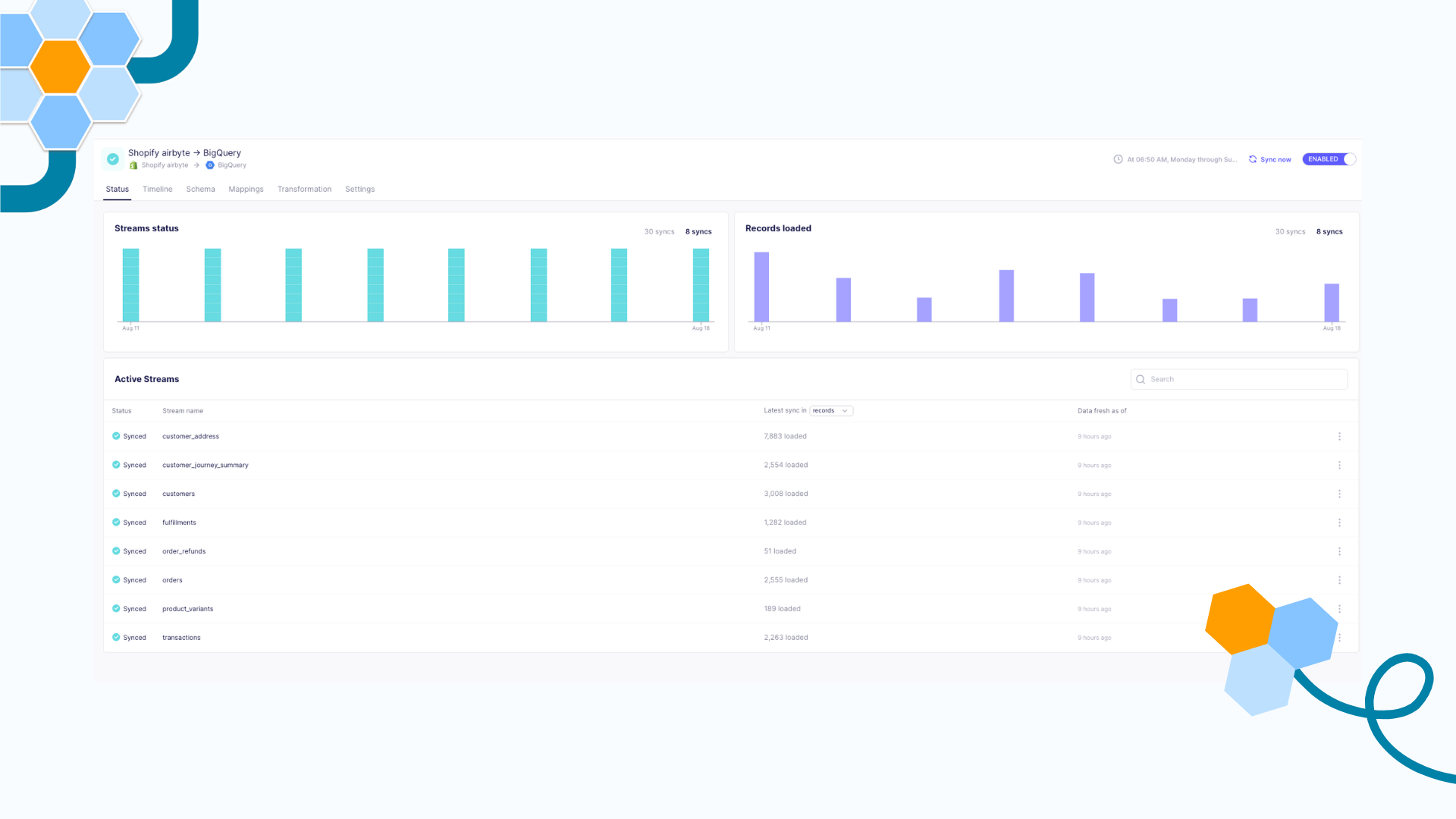
We start by adding connectors for the standard sources, and build custom connectors only for the ones that don't exist. Orchestration handles dependencies and retries.
Which data warehouse and which transformation tool should you choose?
The warehouse choice depends on your volumes, your in-house skills and your budget. Transformation through dbt in layers keeps the model readable for analysts.
How do you industrialize without piling up technical debt?
The stack is assembled like a product: separate environments, code review, controlled deployment, and a metrics layer shared across tools.
The method, in four stages
Source mapping
Volumes, fields, expected freshness and how each team actually uses the data.
Target architecture
Multiple environments, chosen stack, component by component, with costs and sequencing signed off in committee.
Build in batches
One business domain shipped to production per sprint (retail, digital, merchandising), tracked in Jira or your own tool.
Handover
Making it usable: documented code, systematic review, and a technical handbook for your teams.
We adapt to your architecture










What the teams we work with say
“We brought in Smart Bees to support the Segment CDP implementation, a key project for our data strategy. They were always available and quick to answer complex technical questions or to move the project along. What really made the difference was how they teach: they managed to make genuinely technical concepts accessible to the Ornikar teams.”
“I've worked with Smart Bees on several data and tracking projects and I can only recommend them. Beyond their technical expertise, they have a real ability to understand the business stakes behind the numbers and to propose concrete solutions. I always valued their availability, their responsiveness and the quality of their recommendations.”
Frequently asked questions
Do we need a warehouse if we have little data?
Not always. Below a certain volume, a simple well-documented model in a tool you already have is enough — and we'll say so plainly.
Can you take over an existing stack?
Yes, that's the most common case: we stabilize what's there before proposing anything new.
How do you keep warehouse costs under control?
Partitioning, deliberate materializations, and monthly monitoring of the most expensive queries.
Can your deliverables be reused without you?
Yes: code versioned in your own repository, generated documentation, and a handover session with your teams.

Thirty minutes, one founder, a straight answer.
We look at your setup on a screen share and tell you whether there's a real engagement here or not.
