

Should you open a ChatGPT Ads account yet, or wait?
The call comes down to your audience's eligibility, not to features. Opening an account costs almost nothing, and Europe has been available self-serve since late August. But a good share of the advertisers asking the question simply have nobody to reach on this channel, and it is that first filter that governs everything else.
Since 24 August 2026, ads have been serving in ChatGPT across Europe, and since late August a company registered in one of those markets can open its own account self-serve, without going through a partner agency or OpenAI's sales teams. We have already looked at what this channel adds to a measurement setup that already runs, in our piece on what measuring ChatGPT Ads changes in your stack. Which leaves the question we have been asked every week since: do we go now, or do we let a few months pass?
The right question is not whether the channel is ready. It is not entirely, and OpenAI says so itself in its documentation. It is whether your buyers are there, and whether you accept steering a campaign with far fewer levers than you are used to. Here is our practitioner's decision grid, what counts as folklore, and the mistakes we already see on this channel. Small spoiler: for some of you, the answer sits in the first section.
Can your buyers even see your ads?
Not all of them. And that single criterion settles the call, long before any question of targeting or budget.
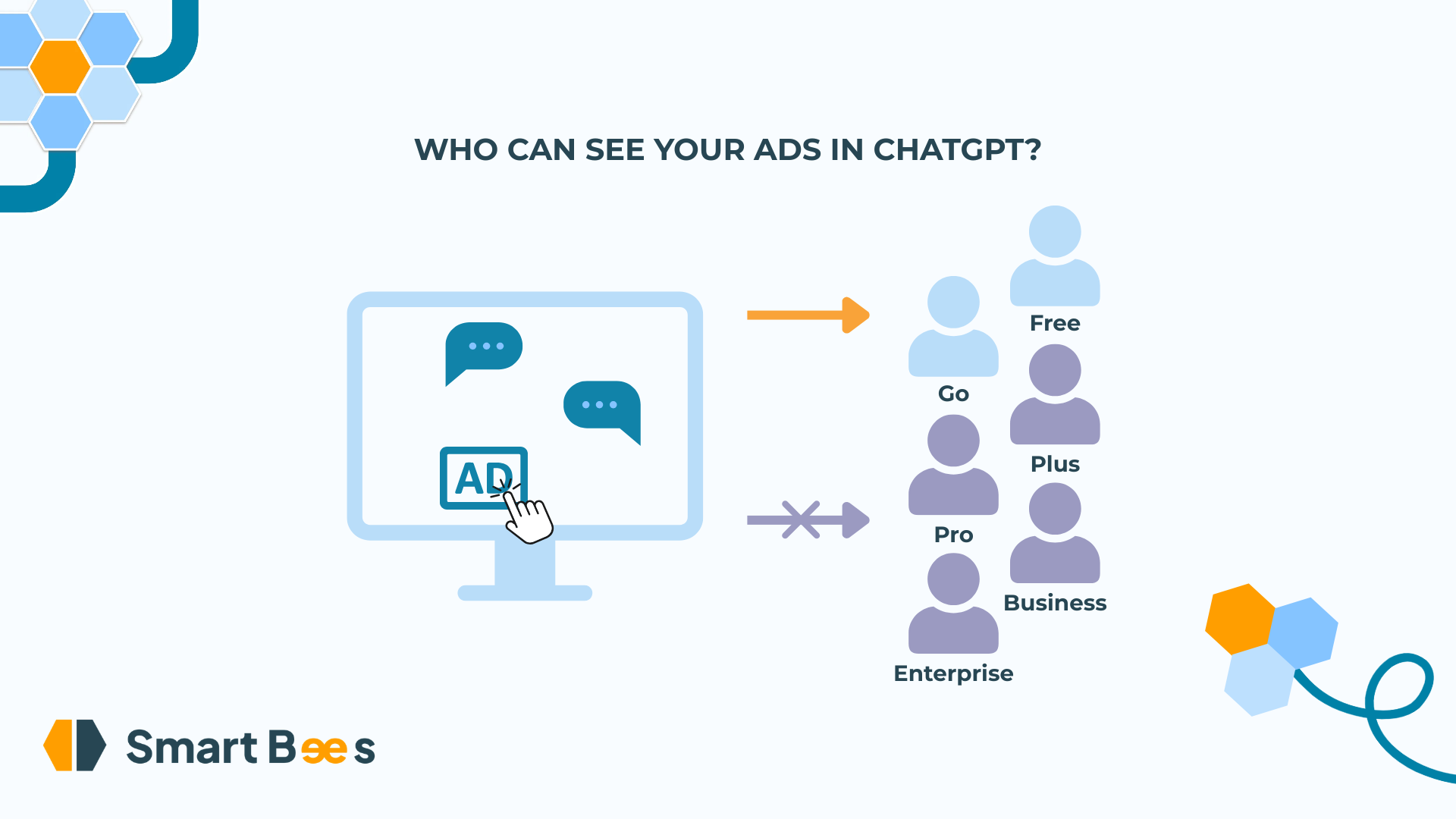
OpenAI only serves on Free and Go. Plus, Pro, Business, Enterprise and Edu accounts see none, and no ad is served to an account identified as belonging to someone under 18. This is not a run-in restriction that lifts in six months: it is written into the publisher's advertising principles.
From that base, the surface shrinks with every paragraph of the documentation. A Free user can switch to an ad-free experience in exchange for tighter usage limits. Temporary chats display no ads, and neither does the Atlas browser during the test phase. Finally, no ad is eligible near sensitive subjects: personal health, mental health, politics. Put end to end, that is a lot of people gone.
So turn the problem around and ask whether your buyer uses ChatGPT for free. If you sell trainers, the answer is yes, and in volume. If you sell software to engineering teams running Business licences for two years, it is probably no. No targeting rescues an audience that is not there. And you will not find that figure anywhere in Ads Manager, which publishes no audience data by plan: on this particular point, you know more than OpenAI.
Can you actually target anyone on ChatGPT Ads?
Not in the sense you mean if you come from Google Ads. The vocabulary looks alike, the mechanism much less so.
Start with what does exist, because it is not nothing. Geographic targeting goes down to postcode depending on the country, and platform targeting covers five surfaces: Android app, Android web, desktop web, iOS app and iOS web. An advertiser arriving from Google Ads is on familiar ground. The one exception is campaigns built on a product feed, which stay confined to country level.
What you are not buying, on the other hand, is keywords. At ad group level you write context hints, that is, phrases describing what you sell, who you sell it to and when it is relevant. The documentation is explicit about their status: they are neither exact matches nor targeting rules, and they guarantee no delivery in any given conversation. You describe, the system decides.
Imported audiences exist, with a floor of 25,000 matched users for an inclusion and a lower threshold for an exclusion. But for campaigns targeting the European Economic Area and Switzerland, OpenAI itself recommends not using them while ads personalisation is unavailable there. In Europe, you therefore leave them aside.
What is left comes down to three things: a geography, a platform, and a description of your offer in plain language. That is contextual buying, not intent buying. If your steering rests on search term lists, per-query bids and fine exclusions, this channel will give you none of those moves.
What is genuinely open today?
More than three weeks ago, and a good deal less than what you will be sold. The table below separates what is genuinely available today from what is not yet.
Read at a glance, the right-hand column looks frightening. It actually describes the normal state of an ad platform six months into its life. Google Ads had no search terms report on day one either. The real question is not how long the list is, it is which of these absences costs you.
Only one really bothers us, and it is the last row. Nobody knows today what good performance looks like on this channel: not you, not your agency, not OpenAI, which states in writing that no performance benchmarks exist yet, whether by advertiser, by sector or by campaign type. You will launch without knowing whether your cost per click is a bargain or a scandal. The rest of the column, on the other hand, you already know how to live with: every ad platform started like this, Google included.
How much does a test that means something cost?
The official floor is low.
What a test that actually teaches you something costs is not.
OpenAI publishes a minimum per billing currency: 15 euros a day for an account billed in euros. A day's spend never exceeds twice the budget you set, and a week's no more than seven times that budget, the week running Sunday to Saturday. On bidding, the publisher suggests starting between 3 and 5 dollars of maximum cost per click.
In other words, enough to test. Not enough to exist.
That floor is not a test budget. A test that means something is a test that clears the noise, meaning one that runs long enough for the system to learn, on a conversion event that fires often enough to be readable. OpenAI's documentation puts it its own way: pick an event with enough signal, because an event that is too rare makes performance impossible to assess.
And media is not the expensive line. The real entry ticket is the setup. You have to declare a conversion source, place OpenAI's measurement tag in your tag manager, gate it behind consent, pick a standard event from a closed list, and tag every landing URL. Taken one by one, none of these moves is hard. Put end to end, I have never seen it fit into the afternoon it is promised in, especially when collection already has holes elsewhere.
Two calendar constraints, finally. A new self-serve account may only be allowed to serve in its home country until identity verification is validated and a first spend threshold is reached. Creating a campaign and setting a budget are therefore not enough, you have to have actually spent. And count the time it takes to declare OpenAI as a recipient in your consent platform, place its measurement tag and check that it stays blocked until the visitor has accepted, exactly as you would for any other ad platform. That is the kind of groundwork covered by our Measurement & Tracking practice practice.
What will you see while the campaign runs?
The basic numbers, and nothing more. Ads Manager shows impressions, clicks, spend, click-through rate, average cost per click, average cost per mille, and conversions if you declare them. You can segment by device, by country and by platform, read the data as a table or a chart, and export it to CSV. Enough to steer spend, not enough to understand why it works.
What is missing says more. No search terms report. No trace of the conversational context your ad appeared in, and no demographic data. You will know that an ad works, you will not know in front of which questions it works. And no, there is no hidden button somewhere to display the queries: we looked too 🙂
For a trade that spent twenty years optimising on search terms, that is quite a change of habit. It is this point, more than the budget, that will make some teams walk away. Also count 24 to 48 hours before an attributed conversion shows up in the reports, so do not judge anything on three days.
One last criterion, and we will not dwell on it because it is covered elsewhere: these reports are only worth what your tags send them. If the tracking plan is out of date, or if the click identifier does not survive the trip through your servers, you will end up with desperately flat columns while the sales themselves keep landing normally. It is all in our piece on what measuring ChatGPT Ads adds to your stack.
What changes if you open now rather than in January?
Less than you are told, and more than nothing. Three things start building up from the first euro actually spent.
What you lose by opening too early is real too. The platform itself warns that it is evolving, on delivery, formats and tools, and that spend can fluctuate during this phase. Above all, a campaign badly framed in September cannot be corrected: it has to be recreated.
Our reading, and it is a reading rather than a measured finding: opening the account costs almost nothing, whereas serving seriously costs a framing exercise. The move to avoid is opening and launching in the same week, telling yourself the settings can be caught up later. Spoiler: no. That is exactly the groundwork we take on upfront in our Measurement & Tracking.
So: do you open, or do you wait?
Three cases, and only one of them justifies opening the account this week.
You sell to consumers and your tagging is already clean: open now. Your audience sits overwhelmingly on the plans that show ads, the spend floor is low, and the settings you cannot change later are worked around by creating several campaigns rather than editing one. The only thing to check before launching is that the measurement tag is in place, gated behind consent, and that your ad URLs are tagged. After that you will learn more in three weeks of serving than in six months of watching.
You sell to businesses whose decision makers hold paid licences: wait. You will pay to reach people who are not your buyers, with no search terms report to notice it and no market benchmark to judge the result. Nothing stops you opening the account now and letting it sleep until the surface widens.
Nobody on the team would watch the account week to week: wait as well. An ad platform that announces it is still changing its own delivery rules needs someone reading the numbers regularly. Without that person you will produce a result nobody can interpret, which is worse than running no test at all.
What mistakes are already showing up?
Four mistakes keep coming back, and always for the same reason: people apply to this channel the reflexes they built on Google Ads or Meta.
Treating context hints as keywords. Someone writes a list of terms, waits for impressions on those terms, and concludes that the platform does not work. The documentation has said the opposite since day one: these are descriptions, not targeting rules.
Believing a cost per acquisition quoted by a third party. OpenAI states in writing that no performance benchmarks exist yet, neither by sector nor by campaign type. Any figure promised on this channel therefore comes from somewhere else, and you will never know where.
Launching before settling what you optimise on. Neither the objective, nor the billing model, nor the conversion event can be changed once the campaign has been created. A campaign that starts wrong does not get fixed, it gets recreated, and the history goes with it.
Wiring an imported audience in Europe. The interface will accept it without blinking, and OpenAI nonetheless recommends not using them in the European Economic Area while personalisation is unavailable there. This is typically the setting you find again six months later, with nobody able to say who put it there.
In closing
If you take one thing away: ChatGPT Ads does not give you measurement of AI traffic, it gives you measurement of this channel is not judged on its features, but on whether your buyers are among ChatGPT's free users. The still-thin targeting, the incomplete reports, the frozen settings: all of that will catch up in time. Not that.
Want to know whether your audience is reachable there, and what it would ask of your collection setup? Talk to a Smart Bees consultant.
Frequently asked questions
What is the minimum budget to run a ChatGPT Ads campaign?
OpenAI publishes a minimum daily budget per billing currency: 15 euros a day for an account billed in euros. A day's spend never exceeds twice that amount, and a week's no more than seven times, the week running Sunday to Saturday. You can also set a campaign lifetime budget, which is the strictest control on overall spend. That floor has nothing to do with the budget needed to get a readable result.
Can you choose the keywords your ad appears on?
No. At ad group level you write context hints: phrases describing your offer, who it is for and when it is relevant. OpenAI's documentation states these are neither exact matches nor targeting rules, and that they do not guarantee delivery in any given conversation. The explicit targeting you get covers geography and platform, not search terms.
Do paying ChatGPT subscribers see ads?
No. Ads only serve on the Free and Go plans. Plus, Pro, Business, Enterprise and Edu accounts see none, and no ad is served to accounts identified as belonging to under-18s. A Free user can also choose an ad-free experience in exchange for reduced usage limits. That is the first thing to factor in when sizing your addressable audience.
Do you still need a partner agency to access ChatGPT Ads in Europe?
Not since late August 2026. Most European markets now appear in the list of countries where Ads Manager is available self-serve, provided the billing entity is established there. Working with OpenAI's sales teams or a partner agency remains possible, particularly for larger budgets. A new account may still be limited to its home country until identity verification and a first spend threshold are met.
Does buying ads improve my visibility inside ChatGPT's answers?
No, the two operate in different places. Ads appear below the answer, clearly marked as sponsored, and OpenAI states as an explicit principle that they do not influence the content of the answer itself. Buying ad space will therefore not get you cited more often in generated answers. These are two separate projects, with two separate budgets.
Is this channel worth opening for you?
Thirty minutes with one of the founders. We look at your audience, your collection setup, and tell you straight whether this channel is worth anything to you today.
